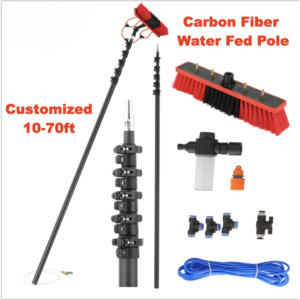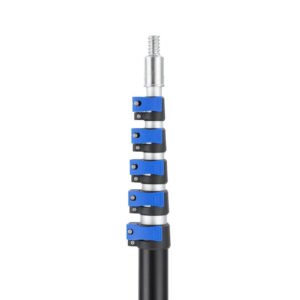
Short answer: match the pole to the working height, then check the weight you will hold all day. Our carbon fiber poles run 12–70 ft (3.6–21.3 m) and weigh 0.56–6.00 kg bare. A 24 ft pole (1.65 kg, 6 sections) covers most two-storey work; 40 ft (2.65 kg, 7 sections) reaches four storeys; 70 ft (6.00 kg, 12 sections) is the practical ceiling for ground-based cleaning. Collapsed length is 147–210 cm, which sets your transport and storage requirement.
A pole can reach a target on paper and still be difficult to use on site. Choosing water-fed pole length means checking the working position, the complete tool setup and the length you will use most often—not simply buying the longest option.
For cleaning contractors and distributors, a useful starting point is a measured job brief followed by a sample check.
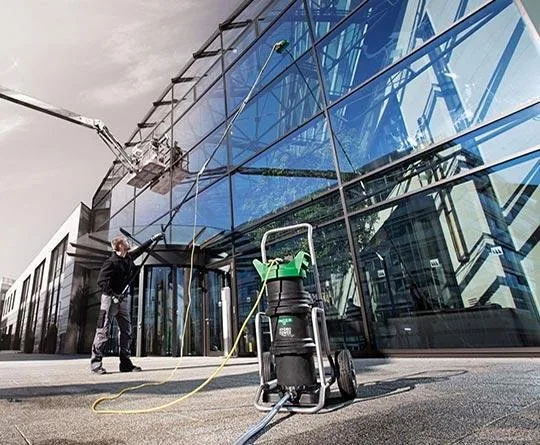
What Do “Extended”, “Working Reach” and “Collapsed” Actually Mean?
Actual extended length describes the pole at its permitted extension. Ask where the measurement starts and ends, and whether the brush or adapter is included.
Working reach or working height is a supplier-defined figure that may include an allowance for the operator. It is not automatically the physical length of the pole. UNGER discusses this distinction in its extension-pole guidance; Gardiner also lists actual length and working reach separately on product pages.
Collapsed length describes the pole when retracted. Confirm whether fitted accessories remain attached for the quoted measurement.
Record all three. Do not assume that a model number or a label such as “30 ft” tells you which one is being quoted.
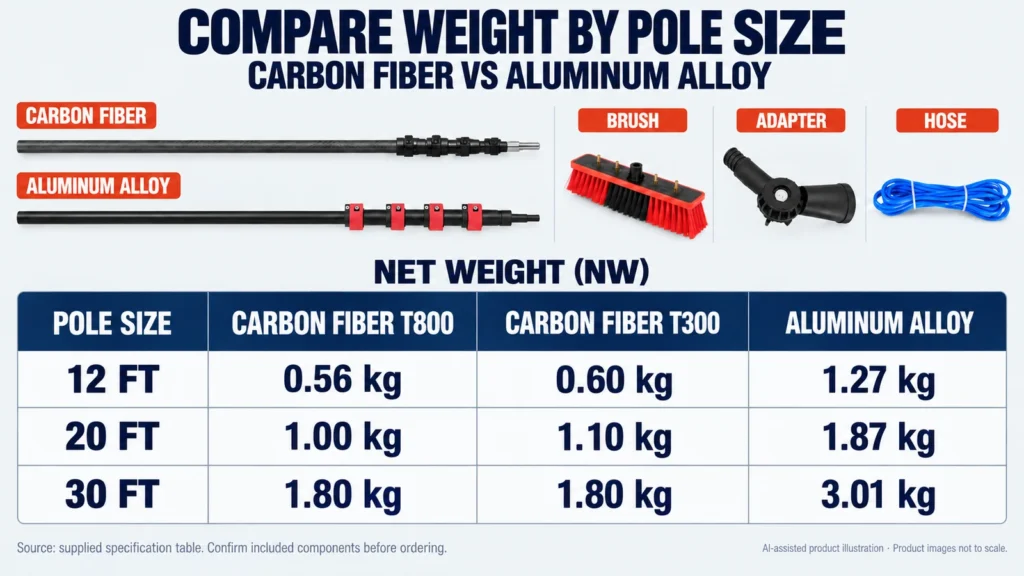
What Does Each Pole Length Weigh?
The figures below are our own carbon fiber telescopic poles, measured as a
bare pole: dry, with no brush, hose, gooseneck or angle adapter
fitted. Add the weight of those parts separately when you compare quotations, and
confirm the same basis with any other supplier before treating two numbers as
comparable.
| Extended length | Carbon grade | Collapsed length | Sections | Bare-pole weight | Approx. storeys |
|---|---|---|---|---|---|
| 12 ft / 3.6 m | T300 | 147 cm / 58 in | 3 | 0.56 kg / 1.2 lb | 1 |
| 16 ft / 4.8 m | T300 | 147 cm / 58 in | 4 | 0.90 kg / 2.0 lb | 1–2 |
| 20 ft / 6.0 m | T300 | 147 cm / 58 in | 5 | 1.01 kg / 2.2 lb | 2 |
| 24 ft / 7.2 m | T300 | 147 cm / 58 in | 6 | 1.65 kg / 3.6 lb | 2 |
| 30 ft / 9.0 m | T800 | 147 cm / 58 in | 6 | 1.90 kg / 4.2 lb | 3 |
| 35 ft / 10.5 m | T800 | 177 cm / 70 in | 6 | 2.30 kg / 5.1 lb | 3 |
| 40 ft / 12.0 m | T800 | 177 cm / 70 in | 7 | 2.65 kg / 5.8 lb | 4 |
| 45 ft / 13.5 m | T800 | 183 cm / 72 in | 7 | 3.00 kg / 6.6 lb | 4 |
| 50 ft / 15.0 m | T800 | 210 cm / 83 in | 8 | 3.30 kg / 7.3 lb | 5 |
| 55 ft / 16.5 m | M40 | 210 cm / 83 in | 9 | 4.00 kg / 8.8 lb | 5 |
| 60 ft / 18.0 m | M40 | 210 cm / 83 in | 10 | 4.60 kg / 10.1 lb | 6 |
| 65 ft / 19.8 m | M40 | 210 cm / 83 in | 11 | 5.10 kg / 11.2 lb | 6 |
| 70 ft / 21.3 m | M40 | 210 cm / 83 in | 12 | 6.00 kg / 13.2 lb | 7 |
How to read this table.
Collapsed length is the transport dimension and drives carton size and
freight class — note that it does not rise evenly with extended length, because
longer poles use longer individual sections rather than simply more of them.
Sections affects both rigidity and the time taken to extend and retract.
Storeys assumes roughly 3 m per storey and the pole worked from ground
level with no operator allowance added; survey the actual building rather than
relying on a storey count.
Why the Carbon Grade Changes With Length
The grade column is not a marketing tier. A longer pole has to resist more
bending moment at full extension, so the fibre specification changes as the
length increases:
| Grade | Lengths | Weight range | Why it is used at this length |
|---|---|---|---|
| T300 | 12–24 ft | 0.56–1.65 kg | Standard-modulus fibre. At these lengths the bending load is modest, so a higher grade would add cost without changing how the pole handles. |
| T800 | 30–50 ft | 1.90–3.30 kg | Higher tensile strength. Keeps deflection controlled as the extended length passes the point where a T300 layup would flex noticeably. |
| M40 | 55–70 ft | 4.00–6.00 kg | High-modulus fibre. Above 50 ft, stiffness rather than strength is the limiting factor, and M40 resists deflection at a weight a standard layup could not match. |
This is worth asking any supplier about. “Carbon fiber”
on its own covers a wide range of materials, and two poles of the same length and
similar price can use very different layups. Ask which grade is used at the length
you are buying.
Two further points worth noting before you compare these numbers with another
quotation. From 12 ft to 30 ft the collapsed length stays at 147 cm while the
extended length rises by 150 %, so transport cost is flat across that whole
range. And weight does not rise in step with length: 30 ft is 1.90 kg while
60 ft is 4.60 kg — double the reach for 2.4 times the weight, because the
sections needed to hold a longer pole steady are necessarily heavier.
How Do You Measure the Job Before Choosing a Length?
Record the target height and the horizontal distance from the intended operating position to the surface. Note recesses, projecting sills, landscaping, parked vehicles and other restrictions that may change access.
For a straight reach path, moving farther from a surface increases the distance the tool must span to reach the same point. The operator’s hand position and the attachment geometry also affect the usable reach. A vertical height measurement alone is therefore not a complete specification.
For sloped solar panels, assess the farthest required cleaning point and access route rather than treating the array as a vertical wall. See our solar panel cleaning poles and brushes for the configurations used on tilted arrays. Select brushes and cleaning methods according to the surface manufacturer’s instructions.
Do not convert building storeys into a fixed pole length. Measure the actual site and confirm the intended method of work.
Should You Buy for Everyday Work or for the Highest Target?
List the extensions used on routine jobs separately from occasional high-reach work. A pole that covers the highest point may still be awkward for frequent lower-level work, especially if its collapsed length or complete-kit weight is inconvenient.
Compare one adjustable model with a shorter everyday pole plus a separate longer option where the workload justifies it. Our custom carbon fiber telescopic poles cover 10–70 ft, so both roles can be filled from one specification. This is a purchasing decision to evaluate through actual jobs and quotations, not a rule that every operator needs two poles.
Ask the manufacturer how sections should be extended and what overlap or stop markings must be respected. Any additional reach must remain within the approved configuration; do not pull sections beyond their limits or improvise extensions.
How Do You Check Control With the Brush and Hose Fitted?
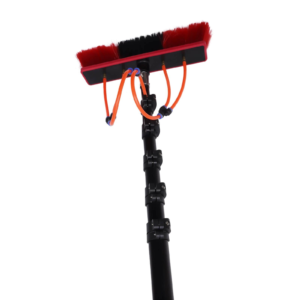
Length alone does not tell you how the setup handles. Record the pole model, material construction, brush, adapter, hose length and the basis of any weight figure. A carbon fiber water-fed pole supplied with its brush is easier to assess than a bare pole, because the balance point is already correct.
Try the sample at your usual extension and at the highest planned operating extension. With natural two-handed handling, assess moving the brush, changing direction and stopping. Keep the comparison conditions consistent and record attachment differences.
Ask whether the operator can maintain useful brush contact and control through the intended task. A handling trial provides practical feedback; it is not a measured stiffness test.
Also check hose routing and delivery at the brush in the intended water setup. Additional extension can require a different hose arrangement; confirm this for the specific system.
Will the Pole Fit Your Vehicle and Storage?
Check the vehicle’s loading opening and usable storage space, not only its overall length. Include room for the brush, adapter, protective storage and any removed sections.
Confirm whether the quoted collapsed dimension includes the tip or attached tool. Every length in our 20–70 ft water-fed pole range collapses to between 147 cm and 210 cm. Ask which components can be removed and how they should be secured for transport.
A pole should fit the complete workflow: unloading, carrying, setting up, cleaning and packing away.
When Is Extra Length the Wrong Answer?
Extra length does not solve every access problem. Review footing, overhead obstructions, electrical hazards, people nearby and weather conditions before selecting an operating position.
Follow the pole manufacturer’s instructions and the site’s working method. Do not assume a carbon-fiber or aluminum cleaning pole provides electrical insulation. Gardiner’s safety guidance is a useful example of the model and task guidance to request.
If the target cannot be reached with an appropriate setup and controlled operation, reconsider the access method rather than relying on additional extension alone.
Frequently asked questions
What length water-fed pole do I need for a two-storey building?
A 24 ft (7.2 m) pole covers most two-storey work when used from ground level, and weighs 1.65 kg bare with 6 sections. Measure the actual eaves height and your standing setback first — a deep setback or a projecting sill can push the requirement to 30 ft (9.0 m, 1.90 kg).
How much does a water-fed pole weigh?
Our carbon fiber poles weigh 0.56 kg at 12 ft, 1.65 kg at 24 ft, 2.65 kg at 40 ft and 6.00 kg at 70 ft. All figures are bare pole, dry, with no brush, hose or adapter fitted. Add those parts separately — a brush and water-filled hose can add more than the pole itself at shorter lengths.
Is working reach the same as pole length?
No. Actual extended length is the physical pole. Working reach is a supplier-defined figure that often adds an allowance for the operator’s height and raised arms, typically 1.5–2 m. Two poles advertised as “30 ft” can differ by that much, so always ask which figure is being quoted.
What is the longest usable water-fed pole?
We supply up to 70 ft (21.3 m) in carbon fiber, at 6.00 kg and 12 sections. Beyond that, deflection and the weight held at arm’s length make controlled brush contact impractical for most operators. If the target cannot be reached at 70 ft, change the access method rather than the pole length.
How long is a water-fed pole when collapsed?
Between 147 cm and 210 cm across our range. Poles from 12 ft to 30 ft all collapse to 147 cm; 35–40 ft collapse to 177 cm; 45 ft to 183 cm; and 50–70 ft to 210 cm. Check this against your vehicle’s loading opening before ordering, not after.
Does more sections mean a weaker pole?
More sections means more joints where deflection accumulates and more clamps to set each time. Our 30 ft carbon pole uses 6 sections while the 70 ft uses 12. The higher-grade fibre used at longer lengths offsets this, which is why the grade changes from T300 to T800 to M40 as length increases.
Should I buy one long pole or two different lengths?
It depends on how often you work at full extension. A 70 ft pole at 6.00 kg is heavy for routine first-floor work that a 16 ft pole handles at 0.90 kg. If high-reach jobs are occasional, a shorter everyday pole plus one long option is usually easier to work with than a single long pole used at partial extension all day.
What Should a Length-Selection Brief Include?
Give the supplier the surface type, measured target height or reach path, operating setback, usual and maximum planned extension, intended attachments, water setup, vehicle/storage limits and cleaning frequency.
Request an exact model recommendation with actual extended length, the definition of working reach, collapsed length, permitted extension configuration and complete-kit details.
Then confirm the proposed setup through a sample check and record the agreed specification. The right length is the one that covers the job while remaining practical to operate, transport and store.
Choose the Right Pole for Your Cleaning Work
Explore our water-fed poles and telescopic poles. Add suitable products to your wishlist, or request a quotation for a complete cleaning configuration.