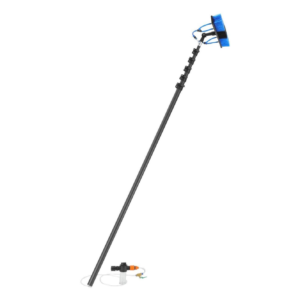
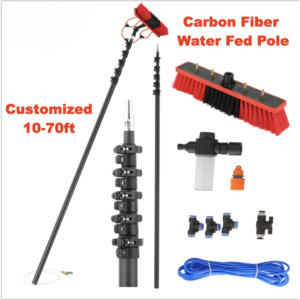
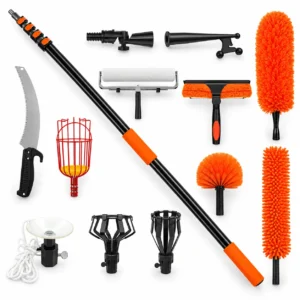
Carbon fiber and aluminum can both be appropriate choices for water-fed cleaning poles. Carbon fiber is often selected when low weight and rigidity are priorities; aluminum is often considered when initial budget matters. Neither material label is a complete product specification.
For contractors and distributors, the useful comparison is between two complete configurations performing the same job. Here is how to make that comparison.
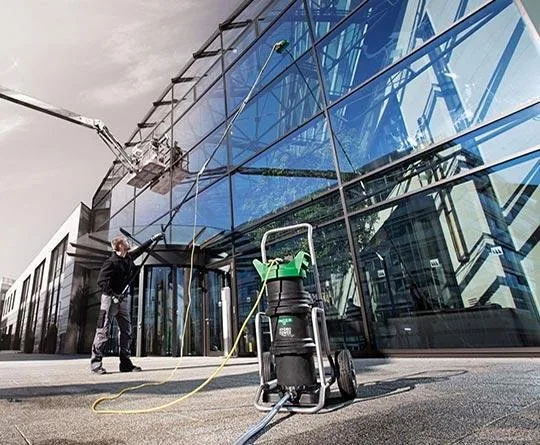
Carbon fiber poles are generally lighter and stiffer at full extension, which helps on frequent, extended-reach work; aluminum poles usually cost less up front and suit occasional or budget-driven use. Both materials can conduct electricity, so neither is a safety feature — the right choice depends on comparing complete kit weight, price and a sample trial under your actual working conditions.
How should you start the comparison between carbon fiber and aluminum poles?
Define the surface, required access, usual extension, session duration and cleaning frequency. Include the operator’s transport and storage constraints.
Short, occasional tasks and frequent extended-reach work may justify different purchasing priorities. Ask suppliers to propose an exact model for the application rather than selecting from a material name alone.
How do carbon fiber and aluminum compare on actual weight and handling?
Carbon-fiber designs can offer a weight advantage, while aluminum often provides a lower-cost entry point. These are general tendencies, not guarantees for every model. UNGER’s material comparison discusses both options in terms of weight, rigidity and price.
Request bare-pole and complete-kit weights separately. Record the brush, adapter, hose length and whether the figure is a dry weight. Do not transfer a material-density percentage into a claimed weight saving for a finished pole.
During a sample trial, use the intended brush and hose. Ask the operator to describe control, balance and effort without converting subjective impressions into an unsupported productivity or fatigue percentage.
What does a supplier’s rigidity claim actually measure?
A carbon label does not prove that a particular pole is stiffer than every aluminum alternative. Tube dimensions, section layout, overlap and joints also affect finished-pole behavior. Clarify whether the carbon product is a hybrid or a specified carbon-fiber construction.
Compare at the same actual extension, angle, attachment load and measurement location. For numerical stiffness or deflection claims, request the support arrangement, test method and results.
A natural two-handed handling trial is useful for operational feedback. It should not be presented as a quantified laboratory stiffness test.
How do you check maintenance and replacement support?
Ask both suppliers for model-specific inspection, cleaning and clamp-adjustment instructions. Confirm how to assess damage after a drop or impact, and when a section must be withdrawn from use. Avoid assuming either material is maintenance-free or automatically lasts longer.
Request a parts list for sections, clamps, end caps and connectors, with replacement pricing and lead times. Gardiner’s maintenance resources are an example of the product-specific guidance buyers should request.
Safety note: material choice does not make a pole electrically safe. Aluminum and carbon-fiber poles can conduct electricity. Follow the equipment instructions and keep clear of electrical hazards. See Gardiner’s safety guidance.
How do you compare the same working configuration?
Use the same brush and adapter where compatibility has been verified. Otherwise, record the different attachments so their effect is not attributed solely to the pole material.
Check the complete pole-tip–adapter–brush connection chain. A change of shaft material does not establish thread compatibility, and it does not by itself determine water delivery.
Keep hose routing and water conditions consistent. Record flow and pressure measurement locations whenever values are quoted.
How do you make the budget decision with evidence?
Consider an aluminum model when it meets the required reach and handling needs and its quotation suits the budget. Consider a carbon-fiber model when sample evaluation shows a useful weight or control advantage for the actual work.
Compare delivered kit price, spare parts, maintenance requirements and warranty handling. Any claimed payback should be calculated from your own operating records, not a generic promise.
For a distributor, the right range may include both materials with clear application guidance and reliable parts support.
Before Ordering, Ask for This Comparison
Request the exact model and material construction; actual extended and collapsed lengths; bare and kit weights; included brush, adapter and hose; compatibility details; the basis of rigidity claims; and replacement-part and warranty information.
Then evaluate samples under the same working conditions and record the agreed configuration.
Quick Comparison Reference
Use this table as a starting checklist, not a verdict. Material labels describe a tendency, not a guaranteed result for a specific pole — always confirm the figures against the exact model you are quoting.
| Comparison Point | Carbon Fiber (general tendency) | Aluminum (general tendency) | What to Verify Per Model |
|---|---|---|---|
| Bare-pole weight | Often lighter for a comparable length | Often heavier for a comparable length | Request bare and kit weights separately, with hose length noted |
| Typical unit price | Usually a higher entry cost | Usually a lower entry cost | Compare delivered kit price, not pole price alone |
| Rigidity | Can offer a stiffness advantage | Can flex more at full extension | Ask for the test method and measurement conditions behind any numeric claim |
| Maintenance approach | Model-specific inspection and clamp care | Model-specific inspection and clamp care | Request the supplier’s inspection and damage-assessment instructions |
| Electrical conductivity | Can conduct electricity | Can conduct electricity | Follow equipment safety instructions near power lines regardless of material |
| Best fit | Frequent, extended-reach work where handling matters | Occasional use or budget-driven purchases | Base the decision on a sample trial under your actual working conditions |
What questions do buyers ask about carbon fiber vs aluminum poles?
Is carbon fiber always lighter than aluminum for the same pole length?
Not automatically. Carbon fiber often offers a weight advantage, but tube dimensions, section count and included accessories also affect the finished weight. Request bare-pole and complete-kit weights for the exact models you are comparing.
Does a carbon fiber pole always cost more than an aluminum one?
Usually, yes, carbon fiber poles carry a higher entry price, but the gap depends on the specific model, length and included components. Compare the delivered kit price — pole, brush, adapter and hose — rather than the pole price alone.
Can carbon fiber and aluminum water-fed poles conduct electricity?
Yes. Both materials can conduct electricity. Material choice does not make a pole electrically safe, so operators should keep clear of overhead power lines and follow the equipment manufacturer’s safety instructions for either material.
How do I know if a supplier’s rigidity claim is reliable?
Ask for the test method, the support arrangement, the load applied and the exact measurement location. A material name alone does not prove stiffness — request numbers that were measured under conditions comparable to your own application.
Should I choose aluminum or carbon fiber for occasional, short-duration cleaning tasks?
For occasional or short tasks, an aluminum pole that meets the required reach may suit a tighter budget. For frequent, extended-reach work, a sample evaluation of a carbon-fiber model may reveal handling benefits that justify the higher cost. Base the decision on your own trial results rather than the material label alone.
Will a carbon fiber pole accept the same brush and adapter as an aluminum pole?
Not automatically. A change of shaft material does not establish thread or connector compatibility. Confirm the full pole-tip–adapter–brush connection chain with the supplier before assuming parts are interchangeable between models.
Compare Pole Options for Your Application
Explore our carbon fiber water-fed poles and aluminum water-fed poles. Add suitable products to your wishlist, or request a quotation for a complete cleaning configuration.