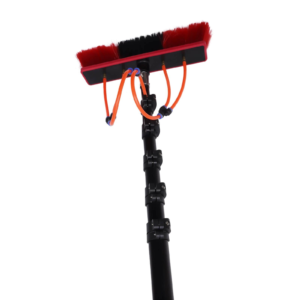
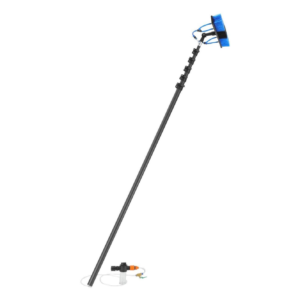
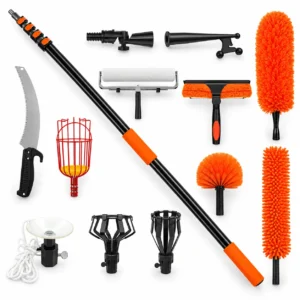
An OEM water fed pole project is more than adding a logo to a telescopic tube. The finished product must match the intended cleaning job, the agreed attachments and the buyer’s acceptance criteria—and repeat that configuration in production.
This guide explains the decisions and records to agree with a supplier, from the first specification to shipment. It describes a purchasing and manufacturing-control workflow, not a claim that every factory uses the same equipment, process or test plan.
An OEM water-fed pole project succeeds or fails on specification completeness: extended/collapsed length with defined measurement points, brush/adapter/hose configuration, material construction and manufacturing route all need to be documented and approved on a working sample before production, not inferred from a photo or a material label.
How do you start with the job and a complete specification?
Define the cleaning surface, permitted working position, required reach path, frequency of use and transport limits. For glass, façades or solar modules, select tools according to the surface manufacturer’s applicable cleaning instructions.
Specify actual extended length and collapsed length with measurement endpoints. Ask how the supplier defines working reach and whether the brush and adapter are included. Separate bare-pole weight from complete-kit weight, and record the hose length and dry or wet condition.
The brief should also identify section count, material construction, clamp arrangement, brush model, adapter, hose routing and water connections. A material label or a product photograph is not a complete specification. See our connection and thread guide when documenting the mating ends.
How do you agree the design, bill of materials and manufacturing route?
Convert the brief into controlled drawings and a bill of materials: part numbers, dimensions, tolerances, material requirements, interfaces, finish and permitted substitutions. Identify which parts are made in-house and which come from approved suppliers.
Composite tubes can be produced by different methods, including roll wrapping, filament winding and pultrusion. In a roll-wrapped route, reinforcement and resin materials are formed around a mandrel and consolidated and cured according to the selected material and process. The route and layup need confirmation for the quoted product; an outer carbon weave does not establish the full construction.
Rock West Composites describes several composite-tube manufacturing methods. Easy Composites provides an example of roll-wrapped tubing with different reinforcement orientations. These are background references, not evidence of a particular OEM supplier’s process.
For an aluminum model, confirm alloy, temper, tube-production route, dimensional controls and finish separately. Do not apply a carbon-composite process description to an aluminum product. Neither a fiber grade nor an alloy name alone predicts the handling of the complete pole.
How do you build and evaluate the complete sample?
Evaluate the intended pole, brush, adapter, hose and valve together. Record sample identity, drawing revision and every component included. Check telescoping movement, clamp operation, straightness and mating interfaces against agreed requirements.
For handling checks, record extension, hand positions, working angle, attachments and hose/water conditions. Observe movement, changes of direction and stopping in an authorized working setup. Treat this as a practical evaluation; numerical rigidity or load claims need a defined method and recorded measurements.
Check mechanical retention and water sealing separately. Follow the exact assembly and test instructions, using specified conditions and suitable equipment. Partial thread engagement is not proof of compatibility. Record observations and corrections rather than assuming a sample has passed because it looks right.
How do you approve a production baseline before releasing the order?
Document the approved sample, drawing revision, bill of materials, artwork, packaging and acceptance checks. State which characteristics will be checked, how they will be measured, the acceptance limits and the agreed inspection frequency or sampling plan.
Agree ownership and handling of tooling where applicable, minimum order quantity, sample charges, lead-time milestones and responsibility for approving changes. A sample approval applies to the recorded configuration; it should not silently authorize a different clamp, resin system, adapter or hose.
How do you control tube production, finishing and assembly?
The production traveler should follow the confirmed manufacturing route. Depending on the design, stages may include material verification, tube forming, curing where applicable, trimming, dimensional finishing, surface treatment and marking. Exact sequences and process parameters belong in the supplier’s controlled instructions.
Inspect the characteristics that matter for telescoping fit and assembly, including agreed lengths, diameters, straightness, surface condition and mating areas. Keep process and material records linked to the batch at the level agreed with the buyer.
During assembly, confirm section order, clamps, stops or retention features, end components and hose routing against the approved bill of materials. Where bonding, fastening or clamp adjustment is used, apply the product-specific preparation, cure or adjustment instructions. Do not invent a universal torque or adhesive procedure.
How do you verify finished products against agreed checks?
A useful inspection record ties each result to a model, revision, lot or sample reference and a method. Checks may cover dimensions, specified weight configuration, telescoping function, clamp retention, accessory attachment, water delivery and leakage. The buyer and supplier should agree which checks apply and whether they are performed on every unit or on a defined sample.
If flow or pressure is measured, record the measurement location, hose length, elevation and supply conditions. Do not substitute pump ratings for delivery at the brush. Repeat-use, environmental or structural performance claims require relevant evidence; one successful handling check does not establish service life.
Record nonconformities, disposition and any rework or reinspection. Release should follow the agreed acceptance process, rather than a generic “QC passed” label without traceable results.
How do you confirm packaging, shipment and replacement support?
Check packing against the actual shipped configuration: protected pole ends and accessories, correct quantities, approved labels, instructions, spare parts and carton identification. Confirm packed dimensions and weight for the shipment rather than using prototype estimates as final values.
Agree the documentation supplied with each order, replacement-part identification and warranty-claim process. Retain the approved configuration and change history so repeat orders can be compared with the original sample. Stock availability, warranty terms and lead time must be confirmed for the specific order.
OEM order-release checklist
| Record | Agreed specification / reference |
|---|---|
| Application and permitted working setup | |
| Model, material construction and manufacturing route | |
| Drawing revision and bill of materials | |
| Length endpoints and weight configuration | |
| Brush, adapter, hose and mating connections | |
| Approved sample and open actions | |
| Inspection methods, limits and sampling plan | |
| Branding, packaging and documentation | |
| Delivery milestones and replacement support | |
| Approved changes and release responsibility |
Frequently asked questions
Does OEM mean a completely new pole design?
Not necessarily. The project may involve private labeling an existing model, changing selected components or developing a new design. Define the scope and validation required before comparing quotations.
Can the logo be approved before the working sample?
Artwork can be reviewed early, but logo approval does not confirm fit, handling or water performance. Keep cosmetic approval separate from product and configuration approval.
What determines manufacturing lead time?
Material availability, tooling, sample revisions, component sourcing, production scheduling, inspection and packaging can all affect timing. Ask for order-specific milestones instead of treating a general lead-time claim as a commitment.
Is OEM customization available for small order quantities?
Minimum order quantities vary by the scope of customization. Private labeling (branding, packaging, color) on an existing model typically has a lower threshold than a new mold or tube specification. Ask the supplier for the specific minimum tied to the customization you need, rather than assuming one minimum applies to every change.
Who owns the tooling or mold created for a custom configuration?
This should be agreed in writing before production, and terms vary between suppliers. Some arrangements have the buyer fund dedicated tooling that remains with the manufacturer for that buyer’s exclusive use; others transfer ownership. Confirm the tooling-ownership, exclusivity and amortization terms in the contract rather than assuming a default.
How are quality disputes on a completed order handled?
Define the inspection method, acceptance criteria and sampling plan before production starts, ideally referencing the approved working sample. If a completed order is found to deviate from the agreed sample or specification, the remedy (rework, replacement, credit) should be specified in the purchase agreement rather than negotiated after the fact.
Can an existing product be modified without a full redesign?
Often, yes. Common modifications include clamp type, tube finish, connector thread, grip material, packaging and branding, which can usually be changed without a new tube mold. A full redesign is typically only needed when the length range, tube diameter or core structural specification changes. Ask the supplier which category your requested change falls into.
What information should be in an OEM quotation request?
Target length range, tube material, intended application, approximate order quantity, branding requirements (logo, color, packaging) and any components to be sourced separately (brushes, hoses, pumps). The more of this that is specified up front, the more comparable the quotations you receive from different suppliers will be.
Planning an OEM water fed pole range? Prepare your application, target configuration, branding requirements and sample-check criteria first. Ask the supplier to return an itemized proposal with drawings, component references, process scope and an agreed inspection plan.