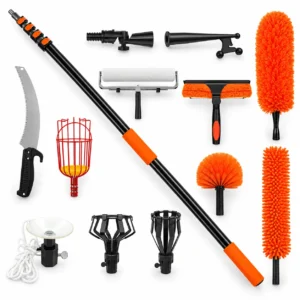
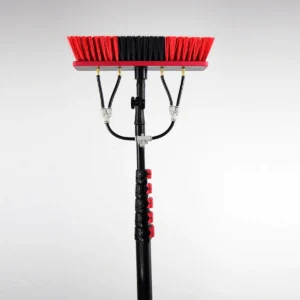
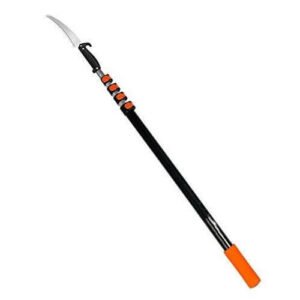
Specify a solar panel cleaning brush and pole in 4 steps: measure array height and row spacing, choose brush width (350 mm for tight rows, 710 mm for open arrays), match pole reach against 6–70 ft options, then confirm water delivery and connector fit for the models quoted.
Most solar cleaning crews compare 2 numbers when buying equipment: brush width and pole length. Those 2 figures decide neither productivity nor panel safety on their own. A 710 mm brush head covers roughly twice the strip width of a 350 mm head per pass, but it is also harder to control at 12 m of extension and will not fit every row gap. This guide sets out the measurements to record on site, the specifications to request in writing, and the checks to run on a sample before standardising a solar panel cleaning brush and pole across a crew.
How do you match a solar panel cleaning brush to a commercial array?
Start with the row geometry rather than the catalogue. Record 3 figures per site: the module long-edge dimension, the walkway or row gap in millimetres, and the number of modules in an unbroken run. A head that is wider than the usable gap forces the operator to work at an angle, which changes both contact pressure and rinse coverage.
A solar panel cleaning brush is then sized by the number of passes it forces per module. A module with a 2,278 mm long edge needs at least 4 passes with a 710 mm head and at least 7 passes with a 350 mm head if you work along the long edge with no overlap allowance. Real passes are higher once you add overlap, so measure your own overlap in millimetres on a trial module instead of assuming a figure.
| Brush format | Nominal width | Typical fit | Trade-off to verify |
|---|---|---|---|
| Single rotating brush machine | 350 mm | Rooftop arrays, narrow PV rows, restricted access | More passes per module; easier handling at longer extension |
| Dual rotating brush machine | 710 mm | Commercial rooftops, utility-scale solar farms | Fewer passes per module; needs row gap and handling capacity to suit |
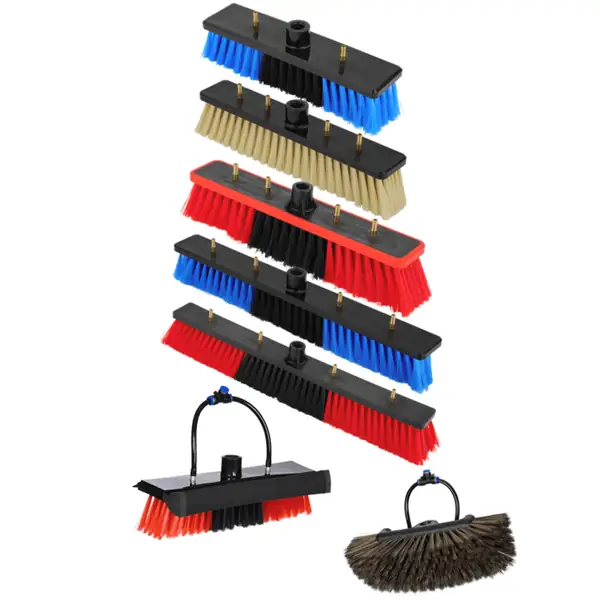
| Manual water-fed brush on a pole | Multiple widths, configuration-specific | Mixed sites, ground-level work, irregular layouts | Operator effort rises with reach; confirm head weight and adapter fit |
The 350 mm single-brush solar panel cleaning machine is listed for maneuverability in smaller arrays and restricted access, while the 710 mm dual-brush washing machine is listed for higher coverage on commercial arrays. Drive, power and machine weight are stated as model-specific on both listings, so request those figures for the exact configuration you intend to quote.
Which solar panel cleaning pole length and material suit ground-based PV work?
Do not convert array height directly into pole length. Record the vertical height of the highest module edge, the horizontal setback from the position where the operator can actually stand, and the brush angle required to keep bristles flat on the glass. A 6 m vertical height with a 3 m setback needs a longer reach path than 6 m, and the usable figure also depends on where the operator’s hands sit on the pole.
Pole systems for this work are offered across a 6–70 ft range, in carbon fiber or aluminum. Carbon fiber is generally specified where carried weight at extension matters; aluminum is generally specified where budget and robustness are weighted higher. Both statements are configuration-dependent, so compare the model-specific weight, section count and collapsed length rather than the material label.

| Measurement to record | Unit | Why it changes the specification |
|---|---|---|
| Highest module edge above the operating surface | m | Sets the minimum reach path, before setback is added |
| Horizontal setback from the standing position | m | Increases the required reach and changes the working angle |
| Row gap or walkway width | mm | Limits usable brush width and the operator’s movement line |
| Module long-edge dimension | mm | Drives passes per module and the cycle time per row |
| Modules per unbroken run | count | Determines hose length, repositioning frequency and crew layout |
| Collapsed pole length and vehicle loading opening | mm | Decides whether the kit transports and stores without disassembly |
For a ground-based manual setup, the 6–70 ft solar panel cleaning poles and brushes are configured as a pole, panel-safe brush, hose and connector package. Where the same crew also cleans glass, the 12–70 ft carbon-fiber water-fed pole with brush lists internal or external hose routing options. Confirm the collapsed length and connector standard for each quoted length rather than for the range as a whole.
How do you compare two quoted configurations on cost per module?
Convert both quotations into the same unit: cost per module cleaned, over a defined period. The inputs are measurable, and every one of them should come from your own records rather than a supplier estimate.
Use 5 inputs: modules cleaned per crew-hour from a timed trial, crew cost per hour, equipment purchase price, expected service life in cleaning cycles, and consumable cost per cycle, including brush replacement and water treatment. Record the timed trial over at least 20 consecutive modules so that repositioning and hose handling are included, not only brushing time.
Worked example, using figures you must replace with your own: if configuration A cleans 90 modules per crew-hour and configuration B cleans 120, B removes 25% of the labour hours for the same array. Whether that difference pays back a higher purchase price depends on annual cleaning volume. The calculation is only as good as the trial behind it, so repeat the timing on the array type you actually service.
What should the sample trial actually test?
A sample check on the proposed solar panel cleaning brush and pole is not a demonstration. Define the acceptance method before the trial, and record results against it. Run the trial on the dirtiest array type in your portfolio, not a convenient one.
Test 5 things and write down each result: cycle time over 20 consecutive modules; brush contact at maximum planned extension, assessed with normal two-handed handling; water delivery at the brush while the system runs at the intended hose length; residue after drying, inspected under the agreed acceptance method; and pack-down, including whether the collapsed kit loads into the vehicle without removing the brush head.
Keep conditions consistent between candidates. Changing the hose length, water source or operator between trials makes the comparison unusable. Note any difference in attachments, because a brush, adapter or hose substitution can change both handling and rinse behaviour.
What belongs in the enquiry you send a supplier?
Send measured operating conditions for the solar panel cleaning brush and pole you need, not a product name. A supplier can only recommend a configuration if the brief states what the equipment has to do.
| Section of the brief | Figures and evidence to include |
|---|---|
| Site and array | Module dimensions, array height in metres, setback, row gap in millimetres, modules per run, roof or ground mounting, access route |
| Work pattern | Cleaning frequency per year, modules per visit, crew size, shift length, soiling type |
| Water and power | Source water availability, any water analysis held, treatment already owned, power availability at the site |
| Equipment to match | Existing pole models, connector standard, hose inner diameter and total run, pump if already in use |
| Commercial scope | Quantity, destination market, branding requirement, required lead time, spare-parts expectations |
Ask the supplier to return an itemised configuration: pole model and extended length, collapsed length, section count, weight, brush width and bristle specification, adapter and connector standard, hose routing, included accessories, consumables and the assumptions that still need a site trial. Compare answers model by model. For related background, see the solar panel cleaning system guide and the guidance on increasing daily cleaning capacity. When the brief is ready, send it through the product enquiry form so that the quotation answers your measured conditions.
What questions do buyers ask about solar cleaning brushes and poles?
Is a 710 mm brush always faster than a 350 mm brush?
No. A 710 mm head covers about twice the strip width per pass, but speed on site also depends on row gap, repositioning distance, handling at extension and hose management. In narrow rows a wider head can force angled working and extra passes. Time 20 consecutive modules with each candidate on your own array type before deciding.
What pole length should a solar cleaning crew standardise on?
Measure the highest module edge, the operator setback and the required brush angle, then choose the shortest configuration that covers the work safely. Poles are offered from 6 ft to 70 ft, but nominal length is not usable reach. Compare model-specific extended length, collapsed length, section count and weight, and trial the intended brush and hose together.
Does carbon fiber always beat aluminum for solar work?
Not automatically. Carbon fiber is usually specified where carried weight at extension is the limiting factor, and aluminum where cost and robustness carry more weight. Both depend on the configuration, not the material name. Request the model-specific weight, section count, wall construction and collapsed length, then compare those figures against your crew’s actual working extension.
Which bristle specification is safe for photovoltaic modules?
Panel-safe bristle options are configuration-specific and must be checked against the module manufacturer’s cleaning instructions. Ask the supplier for the bristle material, filament diameter, stiffness and water-outlet arrangement for the exact head quoted. Do not assume that a brush sold for glass is approved for coated photovoltaic surfaces, and record the approved cleaning method in writing.
Will a brush head fit any pole I already own?
No. Pole tops, gooseneck adapters, thread standards and hose connections differ between models and suppliers. Send the supplier your existing pole model, thread type, hose inner diameter and adapter photographs, then obtain written confirmation of each mating fitting. Checking compatibility before ordering avoids adapters that leak, loosen under load or reduce flow at the brush.
How many passes per module should I plan for?
Calculate it from the module long edge and the brush width, then add your measured overlap. A 2,278 mm long edge needs at least 4 passes with a 710 mm head and at least 7 with a 350 mm head before overlap. Measure the overlap you actually use on a trial module, because soiling level and operator technique both change it.
What should a quotation include besides the brush and pole?
Ask for an itemised list: adapter and connector standard, hose routing and length, water treatment or pump if required, spare bristles and wear parts, packaging, collapsed carton dimensions, MOQ and lead time. Request the assumptions the supplier has made about your site. An itemised scope makes two quotations comparable instead of only their headline prices.
Brush, pole and connector specifications are model- and site-dependent. Confirm the configuration in writing and follow the module manufacturer’s cleaning instructions and applicable site-safety requirements.