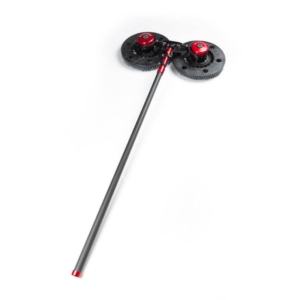
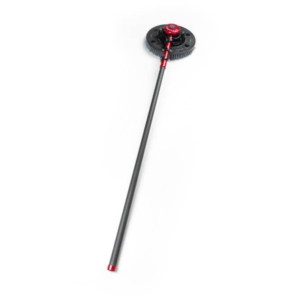
Short answer: start from the array layout, not the site’s megawatt rating. Residential rooftops are typically worked with a 20–24 ft pole (1.01–1.65 kg); ground-mount rows with 20–30 ft (1.01–1.90 kg); large utility arrays with 30–40 ft (1.90–2.65 kg) and a 710 mm dual-brush machine. Confirm the module manufacturer’s cleaning instructions first — they set the limits on brushes, water quality and chemicals before any equipment choice.
A solar panel cleaning system is more than a long pole and a brush. Buyers need a workable combination of access, module-compatible tools, water delivery, operating procedures and replacement support.
This guide focuses on manually operated water-fed systems for cleaning contractors, distributors and procurement teams. Rotating brushes, robots and vehicle-mounted systems need their own module-specific review.
What Do You Need to Know About the Modules First?
Record the module manufacturer and exact model before requesting equipment. Obtain the applicable cleaning instructions and identify restrictions on brushes, chemicals, water quality and loading.
These requirements vary. Canadian Solar’s manual discusses approved cleaning substances and calls for advance consultation on rotating brushes. JinkoSolar’s cited manual prohibits chemicals. Neither should be treated as a universal instruction for every panel. See Canadian Solar cleaning guidance and JinkoSolar installation manual, section 6.2.
Then describe the work: roof or ground-mounted array, slope, farthest cleaning point, permitted standing position, obstructions, soil type, cleaning frequency and available water.
The far edge of a sloped array can be the limiting point. Building height alone does not define the required pole length. Our solar panel cleaning poles and brushes are configured around that measured distance rather than a storey count.
Equipment by Installation Type
The right configuration is set by how the array is mounted and how far the
operator stands from the furthest module — not by the site’s megawatt rating
alone. The table maps the common installation types to a starting configuration.
| Installation type | Typical reach required | Pole length | Bare-pole weight | Cleaning head |
|---|---|---|---|---|
| Residential rooftop | Ground to single-storey roof | 20–24 ft / 6.0–7.2 m | 1.01–1.65 kg | Water-fed brush |
| Commercial flat roof | Walk-on access, short reach | 12–20 ft / 3.6–6.0 m | 0.56–1.01 kg | Water-fed brush or 350 mm single-brush machine |
| Ground-mount array | Across a tilted row from one side | 20–30 ft / 6.0–9.0 m | 1.01–1.90 kg | 350 mm single-brush or 710 mm dual-brush machine |
| Large utility-scale array | Long rows, repeated passes all shift | 30–40 ft / 9.0–12.0 m | 1.90–2.65 kg | 710 mm dual-brush machine |
| Elevated or awkward access | Carport, canopy, restricted standing position | 40–70 ft / 12.0–21.3 m | 2.65–6.00 kg | Water-fed brush, configuration confirmed per site |
Weights are bare pole, dry. A cleaning
machine fitted to the pole adds its own weight at the far end, where it has the
greatest effect on how the setup handles. Confirm the combined figure for the
exact configuration before committing a crew to a full shift with it.
Brush width on its own does not establish daily capacity. A 710 mm head covers
more glass per pass than a 350 mm head, but throughput also depends on row
spacing, ground conditions, water supply and how often the crew repositions —
which is why we quote capacity against a described site rather than as a single
figure.
Where Can the Operator Actually Stand?
A longer pole does not resolve every access problem. Decide where an operator may stand, how hoses will be routed and how the work area will be controlled.
Arrange electrical precautions and any required isolation through qualified personnel and the site procedure. Modules can still generate electricity in light; switching off an inverter does not make the modules electrically harmless. Stop if glass is broken or wiring is exposed, and refer the issue to the responsible professional.
Carbon-fiber poles conduct electricity. Do not treat carbon construction, an insulated handle or purified water as electrical protection. Assess overhead lines and the entire possible movement of the pole. See the Gardiner water-fed pole safety guide.
How Do You Specify the Pole, Brush and Adapter Together?
Ask for actual extended length, collapsed length and the supplier’s definition of working reach. Record whether the brush and adapter are included in those measurements.
Compare handling with the intended head and hose fitted. Bare-pole weight alone does not describe the complete working load — our carbon poles run 0.56 kg at 12 ft to 6.00 kg at 70 ft before any brush is added. A pole quoted with its matched brush is easier to assess, because the balance point is already set.
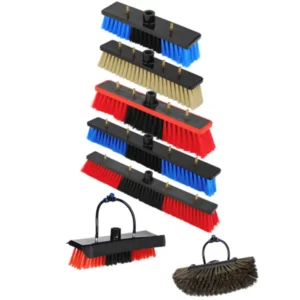
For the brush, request the exact model, bristle material, head dimensions, weight, water outlets and written suitability for the relevant module surface. A red-and-black appearance or a “solar brush” label does not establish coating compatibility.
For every pole-tip, adapter and brush interface, confirm the connection type, locking method and model match. Include photos or drawings in the agreed quotation. Do not assume that two threaded parts fit because they look similar.
Do You Need RO, DI or Neither?
Ask what water is available at the site and what the module instructions require. Record supply consistency and relevant water-quality measurements before selecting treatment.
DI systems use ion-exchange resin to remove dissolved ions. RO systems use membranes; an RO/DI arrangement adds a polishing stage. Treatment selection should account for source water, required output, consumables and operation. RO also produces a concentrate stream that needs an appropriate disposal arrangement. See the UNGER pure-water system overview.
Not every installation needs the same treatment equipment. A portable tank is not automatically a purifier. Ask what each supplied unit actually does, and where treated-water quality will be checked. Our RO/DI purification system is specified against the inlet water you actually have on site.
How Do You Verify Water Delivery at the Brush?
A useful functional checklist is: water source, treatment if required, storage if required, pumping if required, hose, flow control and brush outlets.
This is not a universal plumbing order. A portable unit may combine storage and pumping. Confirm the actual layout with the equipment supplier.
Document hose internal and external diameter, total hose length, elevation, fittings, valve and brush outlet configuration. Request operating flow at the brush and pressure at a named measurement point, with the test conditions stated.
Do not substitute a pump’s maximum rating for measured delivery through the working system. The configured equipment must remain within the applicable module and component limits. More pressure is not a purchasing objective by itself.
What Should a Sample Evaluation Cover?
Before a larger order, agree a sample evaluation using the planned extension, standing position, brush, adapter, hose and water supply.
Check whether the operator can move, redirect and stop the head with control; whether clamps and joints retain their settings; and whether water delivery remains consistent. Inspect for leakage and record the configuration used.
Have the site operator approve a suitable trial area and cleaning method. Follow the module instructions on temperature, permitted tools and cleaning substances. Keep abrasive contamination off the brush.
Record observations and acceptance criteria. An informal handling check is not a measured stiffness test, and a successful small trial does not replace manufacturer requirements.
What Does the Complete System Cost to Run?
Request an itemized quotation covering the pole, brush, adapter, hose, fittings, valve, optional treatment or pumping equipment, and the agreed spares. For larger arrays, compare a pole-and-brush setup against a 710 mm dual-brush washing machine on the same row layout before deciding.
Ask about replacement heads, clamps, pole sections, seals and treatment consumables. Confirm part numbers, maintenance instructions, lead times, exclusions and the warranty-claim process.
Compare delivered kit cost and ongoing consumables using your own work pattern. Do not assume one material is always cheaper over its service life.
Frequently asked questions
What length pole do I need for solar panel cleaning?
It depends on the farthest cleaning point from a permitted standing position, not the building height. Residential rooftops are typically worked with 20–24 ft (1.01–1.65 kg), ground-mount rows with 20–30 ft (1.01–1.90 kg), and large utility arrays with 30–40 ft (1.90–2.65 kg). Measure across the tilted row, not vertically.
Can I use tap water to clean solar panels?
Only if it dries without leaving deposits, which most mains supplies do not. Dissolved minerals remain on the glass as the water evaporates, which is why pure-water systems use RO, DI or an RO/DI combination. Check the module manufacturer’s instructions for the water quality they require before choosing treatment.
Is a wider brush always faster?
No. A 710 mm dual-brush head covers more glass per pass than a 350 mm single-brush head, but throughput also depends on row spacing, ground conditions, water supply and how often the crew repositions. Brush width alone does not establish daily capacity.
Do carbon fiber poles protect against electric shock?
No. Carbon fiber conducts electricity. Neither an insulated handle nor purified water makes a pole electrically safe. Modules generate current in daylight and switching off an inverter does not make them harmless. Assess overhead lines across the pole’s entire range of movement, and arrange isolation through qualified personnel.
What is the difference between RO and DI?
DI uses ion-exchange resin to remove dissolved ions. RO uses a membrane, and an RO/DI arrangement adds DI as a polishing stage after the membrane. RO also produces a concentrate stream that needs somewhere to go. The right choice depends on your inlet water, required output volume and consumable cost.
How often should solar panels be cleaned?
Follow the site’s maintenance plan and actual soiling conditions — dust, pollen, bird fouling and rainfall patterns all differ by location. Be cautious of any supplier promising a fixed energy-recovery percentage; that claim needs site-specific evidence measured under your own conditions.
Can one pole cover both residential and utility-scale work?
A 30 ft pole at 1.90 kg handles most residential and ground-mount work. Utility arrays with long rows usually justify 40 ft (2.65 kg) or a dedicated washing machine. Weigh the cost of one long pole used at partial extension all day against two lengths matched to each job type.
What Should the Order Specification Contain?
Send the supplier a brief containing:
- Module make, model and applicable cleaning instructions.
- Array layout, access and farthest cleaning point.
- Routine and maximum planned extension.
- Exact brush, adapter and connection requirements.
- Source water, treatment needs and delivery conditions.
- Transport, storage and operating constraints.
- Sample reference, acceptance checks and agreed changes.
- Included parts, exclusions and replacement support.
Cleaning frequency should follow site conditions and the applicable maintenance plan. Energy recovery cannot be promised as a fixed percentage; any claim needs site-specific evidence that accounts for changing operating conditions.
A complete purchase starts with a defined job, continues with a verified configuration, and ends with a specification both parties can check.
Planning a system? Share your module model, array layout, working distance and water conditions when requesting a quotation.
Originally published by Lily Sze on LinkedIn.