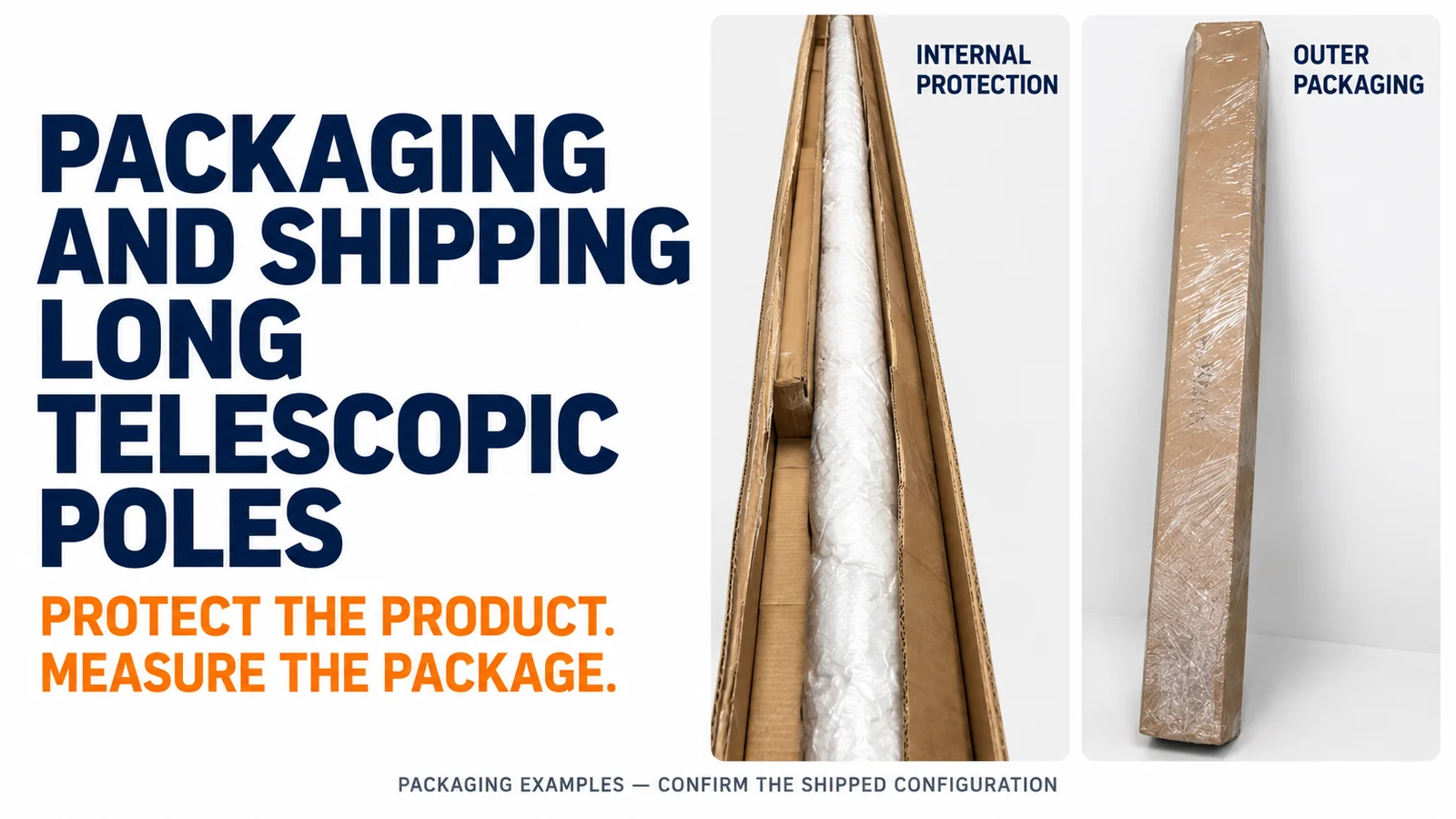
Packaging and shipping long telescopic poles requires more than choosing a long carton. The package needs to protect the collapsed pole, restrain movement, separate vulnerable accessories and match the handling conditions of the selected transport service.
For distributors, OEM buyers and cleaning-equipment suppliers, the best starting point is the actual shipped configuration. A pole’s working reach does not tell you its packed length, and a low product weight does not necessarily mean a low transport charge.
This guide sets out the information to agree before dispatch. Packaging construction, test requirements and service eligibility must be confirmed for the specific product, route and shipment.
Packaging a long telescopic pole for shipment means protecting the collapsed tube ends and clamps, restraining the contents so nothing shifts or contacts the brush, and measuring the final closed package (not the collapsed pole length) to get an accurate freight quote. Confirm the test protocol, carrier limits and wood-packaging rules for the specific route before booking.
What exactly should be defined about what will be shipped?
Record the pole model, collapsed length, number of poles per package and all included accessories. State whether brushes, adapters, hoses and valves will be fitted, separately restrained in the same carton or shipped in another package.
Retract and secure the sections according to the manufacturer’s instructions. Remove accessories only by an approved method. Do not shorten a pole for shipping by dismantling sections or removing retention features unless the manufacturer permits it and provides reassembly instructions.
For a used or demonstrated water-fed kit, follow the equipment instructions for draining and drying before packing. Keep the shipment contents consistent with the quotation and packing list. Our OEM manufacturing guide explains how to link the sample, configuration and order records.
How do you protect the ends, clamps and surfaces?
Identify contact points that could be damaged by impact, rubbing or concentrated loading: exposed pole tips, threaded ends, clamp levers, tube surfaces and attached fittings. Choose protective materials that are compatible with the finish and do not leave damaging residue.
End protection should keep a pole tip from bearing directly against or puncturing the carton. Internal supports should prevent movement while avoiding excessive local pressure on tubes or clamps. The material, support positions and clearances need to be designed and checked for the actual model.
Do not rely on tightening clamps harder than specified or wrapping tape directly around working parts to make the package stable. A “fragile” label is a handling instruction, not a substitute for protection. General FedEx packing guidance also emphasizes suitable outer packaging and cushioning; a pole-specific design still needs its own evaluation.
How do you restrain the contents and separate accessories?
A long pole should not slide from end to end, roll freely or strike neighboring products inside its package. Use a defined arrangement of supports, separators or compartments to control movement without bending the pole into the container.
Pack the brush so the bristles and water outlets are protected from other hard components and sustained compression. Restrain adapters, valves and small fittings separately so they cannot hit or scratch the pole. Coil the hose according to its handling requirements rather than forcing tight kinks.
For multi-pole cartons, prevent pole-to-pole contact and confirm that dividers remain effective during handling. Do not assume that a protective sleeve alone controls movement. A kit diagram and packing sequence help the packing team reproduce the agreed layout.
How do you select the outer package for the route?
Compare a suitable long carton, protective shipping tube, crate or supported freight unit against the product and transport requirements. No one format is automatically suitable for every long pole. Confirm closure strength, resistance to crushing and puncture, and how the unit will be lifted, sorted, stacked or transferred.
If using a pallet or crate, design the support for the full load and avoid unsupported ends or product overhang. Strapping and edge protection must secure the packaging without crushing the poles. Confirm lifting access, handling equipment and permitted stacking with the logistics provider.
FedEx Freight packing guidance highlights the need to secure long items so they do not endanger other cargo. For export wood packaging or other regulated materials, have the forwarder confirm the applicable destination and transit requirements before manufacture. Do not copy an approval or treatment mark onto an unverified package.
How do you measure the final closed package?
Measure each fully packed and closed shipping unit at its outermost points, including bulges, end protection and projections. Record length, width, height, gross weight and units. For freight, include the pallet or crate in the measurements and weight.
Keep product net weight, packed gross weight and carrier chargeable weight separate. A carrier may calculate dimensional weight and apply additional handling or oversize charges under its service rules. Confirm the current divisor, rounding method, limits and surcharges for the origin, destination and selected service.
UPS measurement guidance describes measuring the extreme points of irregular packages. If a service requests length plus girth for a rectangular package, that measurement is length + 2 × width + 2 × height; the applicable limit still depends on the service. Do not quote freight from collapsed pole length alone.
How do you validate the package and agree the shipment?
Review a representative packed sample with the actual contents, restraints, closure and accessories. Where transport testing is needed, agree a protocol appropriate to the distribution environment with the carrier, packaging specialist or testing provider. Do not invent a drop height, stack load or universal test procedure.
Define what will be inspected after testing: outer-pack condition, product damage, telescoping function, clamp operation, accessory integrity and applicable connection checks. Record the package revision, contents, method and observations. A photograph of an intact carton is not proof that the product inside remains functional.
Obtain a shipment-specific quotation using the final package data. Confirm service acceptance, collection and delivery access, unloading arrangements, transit estimates, included and excluded charges, and who coordinates problems. Clarify cargo-cover terms and the carrier’s claim process; declared value and insurance should not be treated as interchangeable without checking the contract.
How do you document dispatch and receiving checks?
Before sealing, photograph the contents and protective arrangement. After sealing, record the label, carton identification, external condition, dimensions and gross weight. Use traceable carton or package references so the buyer can connect a delivery to the packing list.
Agree what the receiver should check on arrival: package count, visible damage, signs of moisture, missing accessories and product condition. Record concerns promptly under the carrier’s procedure, retain packaging when required for investigation and follow the manufacturer’s inspection instructions before using a potentially damaged pole.
For repeat orders, retain the approved packing method and revision history. A change in collapsed length, clamp layout, brush model or number of poles per carton can require the packaging to be reassessed.
A shipping brief you can copy
| Check | Shipment-specific response |
|---|---|
| Model and shipped configuration | |
| Quantity per package and total package count | |
| Packing design and revision | |
| Final external length × width × height, with units | |
| Gross weight per shipping unit | |
| Route, service and handling restrictions | |
| Package evaluation and acceptance record | |
| Quote basis, exclusions and delivery access | |
| Dispatch photos and packing-list reference | |
| Receiving and damage-reporting procedure |
Frequently asked questions
Is collapsed length the same as shipping length?
No. Shipping length includes the finished packaging and protective space around the product. Measure the closed package rather than calculating it from a pole specification.
Should the brush always be removed?
Not automatically. Compare the approved fitted and detached configurations, including protection, package dimensions and correct reassembly. Follow the manufacturer’s instructions.
Can a long lightweight pole use a standard parcel service?
Possibly, but low weight alone does not establish acceptance. Confirm the package dimensions, shape and handling requirements with the selected service before booking.
Does the packaging need to differ between air freight and sea freight?
Often yes. Air shipments are typically more sensitive to dimensional weight and oversize surcharges, while ocean and multi-leg freight may involve more handling transfers and longer transit times. Confirm the packaging design against the specific service and route rather than assuming one package suits every mode.
How many poles can share one shipping carton?
This depends on the model’s collapsed length, diameter, weight and the carton’s structural rating. A multi-pole carton needs dividers or supports that keep poles from contacting each other, and the final loaded weight needs to stay within the carton and pallet’s rated capacity. Ask the supplier for the tested configuration rather than estimating from a single-pole package.
What should the packing list include?
At minimum: model and configuration per unit, quantity per carton, total carton count, net and gross weight, and carton dimensions. For OEM or mixed orders, list any branding variants or accessory kits separately so the receiving team can reconcile the shipment without opening every box.
Is wood packaging always required for export shipments?
No. Requirement depends on the packaging material actually used and the destination country’s import rules. If solid wood packaging material is used, it typically needs to meet the destination’s phytosanitary treatment and marking requirements; cartons, foam and plastic dunnage generally fall outside those rules. Confirm with the forwarder for the specific lane rather than assuming a blanket requirement.
What happens if a package exceeds a carrier’s length or girth limit?
The shipment may be rejected, rerouted to a freight service, or charged an oversize fee, depending on the carrier’s rules. Long telescopic poles are more likely to approach these limits than most cleaning equipment, so check the selected carrier’s current maximum length and length-plus-girth allowance before finalizing the package design, not after booking.
Preparing a telescopic-pole shipment? Ask the supplier for a packing-layout reference, final closed-package measurements, gross weights and a complete packing list before comparing transport quotations.