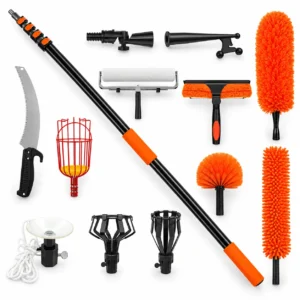
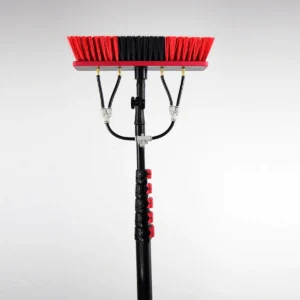
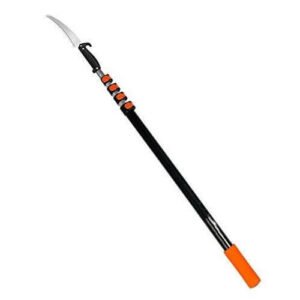
A complete water fed window cleaning setup has 6 connected parts: a pure-water system, a TDS meter, a supply hose or reel, the pole hose, a telescopic pole, and a brush. Water is treated first, checked for dissolved solids, then delivered through the hoses and pole to the brush. Confirm each connection before ordering.
For a professional crew, a water fed pole setup is not just a pole with a brush. It is a route for water from the source to the glass, plus a way to monitor water quality and control the brush at the work face. This guide maps that route, explains the purpose of each part, and gives buyers a practical checklist for specifying water fed window cleaning equipment without assuming that every hose, pump, thread or pole is interchangeable.

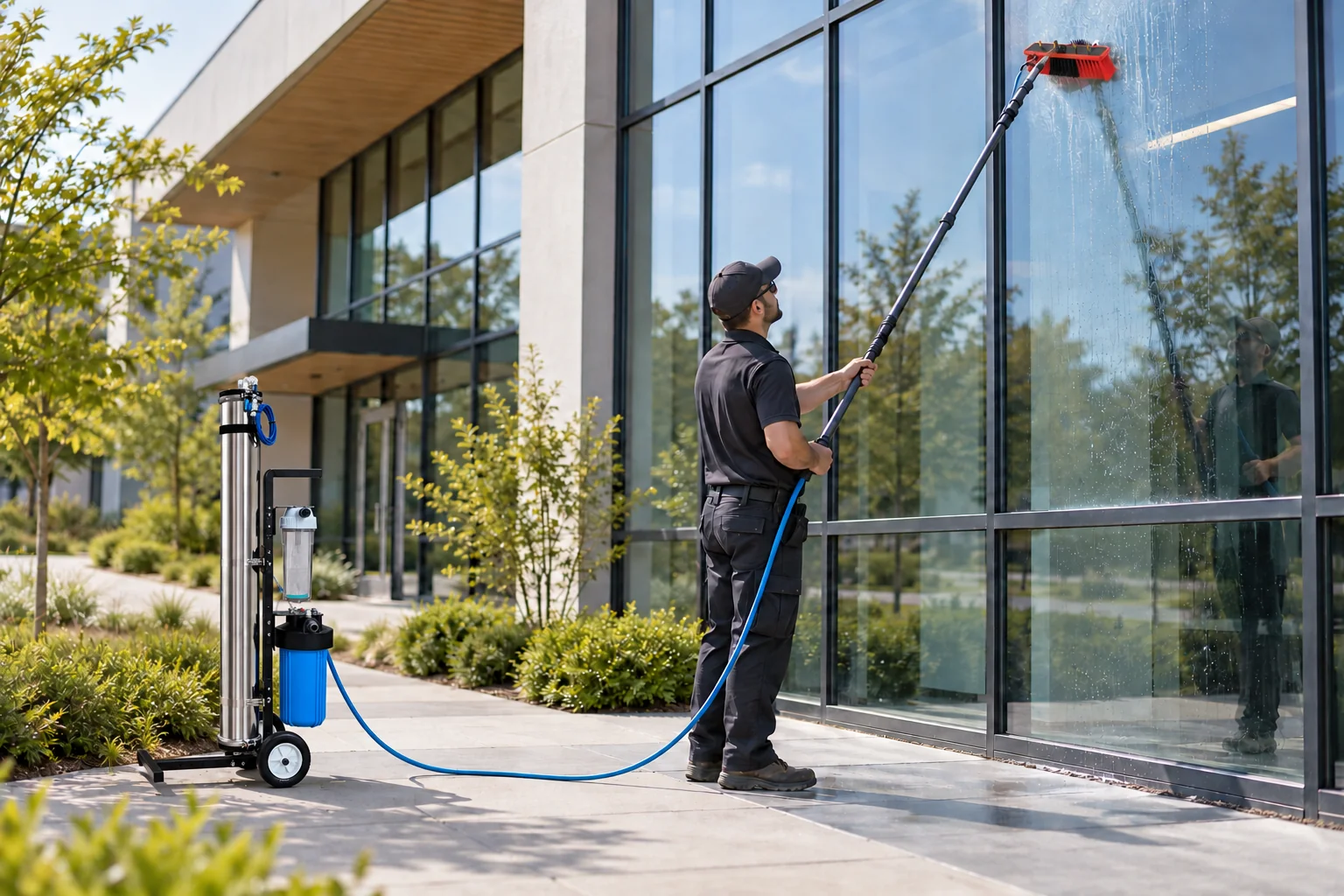
How does water move through a complete water-fed pole setup?
The normal process starts at a site water source. Depending on the selected system and local supply, pre-filtration may protect later treatment stages; reverse osmosis (RO) and deionisation (DI) may then be used to reduce dissolved minerals. The exact treatment stages are configuration-dependent, so buyers should request the equipment flow diagram and operating instructions for the model they intend to use.
After treatment, a TDS meter gives an operational reading of dissolved solids at the point being checked. Record where the sample is taken—for example, at the treatment outlet or at the end of the delivery line—because a reading at one point does not automatically describe water at another. TDS is a measurement aid, not a substitute for the system maker’s service or cleaning guidance.
Water then travels through a supply hose, sometimes managed on a reel, to the pole’s water line. Some poles route a hose internally; others use an external line. At the top, the pole connects through a gooseneck or angle adapter to a brush. A brush manifold distributes water through its outlets while the bristles agitate the glass. The order is straightforward, but its fittings and hose arrangement must match the chosen models.
Which components belong in the equipment specification?
| Stage | Role in the setup | What to confirm before purchase |
|---|---|---|
| Water source and treatment | Provides feed water and reduces dissolved minerals through the selected filtration configuration. | Feed-water conditions, treatment stages, service parts, rated output and installation instructions for the exact model. |
| TDS meter | Checks a water sample and helps the operator monitor treatment performance. | Meter type, calibration/maintenance instructions and the stated sampling point; do not assume a universal pass value. |
| Supply hose or reel | Moves treated water from the system toward the operator and helps manage hose length on site. | Hose inner diameter, total run, fittings, reel compatibility and whether pressure/flow requirements are met by the selected system. |
| Pole hose | Feeds water up the telescopic pole to the brush. | Internal or external routing, hose length, connection size and a compatible path through any reel or pump. |
| Pole, adapter and brush | Provides reach, operator control, brush angle and water distribution over the glass. | Working reach, handling, pole top fitting, brush width/type, jet arrangement and the cleaning method approved for the glass. |
Use this table as a quotation checklist rather than a promise that one bundle contains every item. For example, the listed RO/DI pure-water system describes configurable filtration, fittings, meters and accessories; the final package is confirmed for its selected model.
How should you choose a pole, hose and brush combination?
Start with the surface and the operator’s normal working position, then choose the shortest workable reach that meets site access and safety requirements. A pole listing’s extended length is not the same as comfortable working reach in every situation. Include the operator’s stand-off distance, brush angle, building features and hose drag in a practical trial. For length selection, record the height reached and the configuration used rather than relying only on a headline number.
Next choose the pole material, number of sections and hose route against the work pattern. A carbon-fiber pole may reduce carried weight relative to some alternatives, but actual weight and stiffness depend on the configuration; request the model-specific data. The 12–70 ft carbon-fiber water-fed pole kit lists internal or external hose routing and configuration-specific connector details. Those details should be confirmed for the selected length and brush.
Brush selection is about the surface, bristle type, width, water outlets and control—not width alone. A larger head can cover more glass per pass but may be harder to control in tight areas or at longer reach. Confirm that the brush’s top connection mates to the pole adapter and that water outlets align with the intended cleaning pattern. The custom pole and brush-head configuration is one option to discuss, not evidence that all pole tops share the same interface.
When is a booster pump or hose reel useful?
A pump may be relevant where the selected treatment unit, source conditions, hose run and work height require assistance with delivery. It is not automatically necessary, and a pump cannot be chosen from pole length alone. Compare the pump’s model-specific inlet, outlet, power, flow and pressure information with the water system and intended hose route. Ask the supplier to confirm the complete operating combination in writing before purchasing.
The portable water-fed pole booster pump is listed in battery and non-battery options; its detailed operating figures are model-specific. Treat a hose reel as a hose-management choice: it can help deploy and recover a long line, but the reel, hose diameter, fittings and operating conditions still need checking together.
What should buyers check before ordering a complete system?
Send the supplier the same operating brief you will use to compare quotations. Include the water source, site type, target working height, expected hose route and whether the crew works from the ground or another approved position. Identify the glass or facade type and any manufacturer cleaning instructions. Ask for a drawing or itemised list showing the treatment unit, meter, pump if required, hose/reel, pole hose, pole, adapter, brush, connectors and consumables.
| Buyer check | Evidence to request |
|---|---|
| Compatibility | Written confirmation of each mating fitting and hose path for the named model numbers. |
| Water and power conditions | Model-specific feed-water, inlet, output and power requirements, plus instructions for measuring performance. |
| Working method | Assembly instructions, brush choice, safe reach guidance, maintenance intervals and replacement part references. |
| Commercial scope | Itemised included/optional parts, sample or pre-shipment checks, packaging, MOQ and lead time for the quoted configuration. |
For example, describe a requirement as “cleaning exterior glass from ground level at a measured working height of 8 m, with a 25 m hose route and an available mains outlet,” if those figures reflect your real site. Do not copy this example as a product specification. The point is to provide measured operating conditions so a supplier can recommend a configuration and identify what still needs a site trial.
How can a crew commission and maintain the setup?
Before the first job, assemble the system using the manufacturer’s instructions and verify each connection with the equipment depressurised where required. Flush new or serviced lines as directed. Check hose routing for kinks, abrasion and trip hazards, then confirm that the brush receives water while the system is operating as intended. Take and record TDS readings at the chosen sampling points, including the date and operating conditions; investigate changes against the equipment manual rather than relying on an internet-wide threshold.
Run a small test area on the actual glass and inspect it using the agreed acceptance method. Adjust brush movement and rinsing only within module, glass and equipment guidance. At pack-down, isolate the supply, drain or store components as instructed, and note any leaks, blocked outlets or damaged sections. A short record of source conditions, sample readings, configuration and service actions helps the next operator reproduce a known setup.
A complete system is therefore a verified chain, not simply a shopping list. If you need a quotation, share the actual site conditions, required reach, hose run, preferred power arrangement, cleaning surface and quantity. You can then request a model-by-model compatibility check and compare like-for-like packages through the product enquiry form.
What questions do buyers ask about water-fed window cleaning setups?
Does every water-fed pole setup need an RO/DI system?
Not every job uses the same treatment arrangement. The appropriate process depends on source-water quality, the required cleaning result, the system design and site procedures. Ask what treatment stages are included and how the supplier recommends checking the output. Do not assume a particular filtration combination or TDS reading is suitable for every water source or glass-cleaning task.
Where should I measure TDS in the system?
Choose sampling points that help you monitor the process, such as the treatment outlet and, where useful, the delivered water near the work end. Label each reading with its location because values from different points are not directly interchangeable. Follow the meter and filtration-system instructions for sampling, calibration and service, and use product-specific guidance to decide what action a reading requires.
Can I connect any hose reel to any water-fed pole?
No. Hose diameter, length, reel ports, pole hose routing and connector standards can differ. A setup may use an external line or a pole with internal routing, and its fittings must match the selected components. Give the supplier the model numbers and hose measurements, then obtain written confirmation of the complete water path before ordering or adapting parts.
How do I know whether a booster pump is required?
Compare the water source and treatment unit requirements with the real hose route, elevation and intended number of active brushes. Ask for the selected pump’s operating data and confirmation that it suits those conditions. A maximum rating by itself does not prove delivery at the brush. Where practical, verify the proposed arrangement under the same conditions expected at the work site.
Which pole length should a window-cleaning company buy?
Measure the target working height and consider the operator’s permitted standing position, setback, brush angle, obstacles, transport limits and handling. Choose a configuration that safely reaches the job without assuming that nominal pole length equals usable reach. Compare model-specific extended and collapsed lengths, section count and weight, and trial the intended brush and hose combination before standardising equipment.
What details should I send for a complete-system quotation?
Provide the water source and any available water analysis, target working height, approximate hose run, cleaning surface, operating location, power availability, preferred pole material, expected daily use and order quantity. Include desired brush type, branding and destination market if relevant. Ask the supplier to return an itemised configuration, fitting compatibility, consumables, service requirements and any assumptions that still need confirmation.
Specifications and compatibility are model- and site-dependent. Confirm the final configuration and follow applicable equipment, glass and site-safety instructions.